
by Anna Strohmenger Italian original version
1.The Earth is alive
 Like any other living thing, the Earth has a microbiome that breathes and metabolizes substances. The species that make up this microbiome account for a quarter of the existing biodiversity on our Planet (FAO, 2015). Although not visible, it consists of many individuals related to each other through an intricate functional network.
A single gram of soil can contain more than 10 billion microbes. Their size is small. In most cases, the diameter is 1-10 microns, always less than a millimeter, so they can be visualized with a microscope that can magnify images 40, 100, and 400 times.
Microbiology has an important trophic function in the soil: it uses the energy plants fix through photosynthesis. Part of this energy is absorbed and retained in their cells, and another part is metabolized to produce different types of molecules. The remains of dead microorganisms will aggregate with soil humus, a sizable energy source for soil life.
Humus is an organic agglomerate, chemically consisting of carbon molecules tightly bonded with mineral atoms embedded; geometrically these bonds form pentagons and hexagons chained together in very stable structures. Humus represents a reservoir of nutrients, which are difficult to degrade, a valuable treasure trove for Earth’s life, and a fundamental reservoir for microbiology. From humus, certain species such as mycorrhizal fungi draw nutrients whenever these are not available in the soil as mineralizable organic matter. While in a natural environment, such as in a forest or meadow, humus accumulation normally occurs at favorable times of the year, in farmland, it occurs if there is: a) a complex and active microbial network, b) healthy plants capable of producing root exudates c) constant renewal of plant roots d) covered soil e) supply of organic matter.
Soil cover impacts microbial life, thanks to its humid microclimate and constant temperature influencing the underlying soil layer. The soil cover also shelters the soil from disturbing climatic events such as wind, rain, and hail, and acts as a shield from direct sunlight, especially UV, which is lethal. The cover consists of foliage, twigs, bark, dry grass, exuviae, and excrement of the meso and macrofauna, forming a nutrient substrate that is decomposed by the microfauna.
It is clear that the energy transfer in the soil food web has a relationship with a) soil fertility management, b) plant health and productivity, and c) the association between plants and microbiology. In fertile agricultural soil, plant roots develop into a living, organized, stimulating ecosystem where fungi and bacteria bridge nutrients dissolved in the soil solution and plant sap (Howard, 1931). Fungi and bacteria constitute the primary consumers of plant-fixed energy, while secondary consumers, protozoa and nematodes prey on fungi and bacteria and release soluble nutrient wastes (amino nitrogen, amino acids, proteins) that are assimilated by plants, through their roots, for their nutritional needs.
The relationship between plants and soil microbiology is an energy exchange that sustains both. This collaboration emerged during the evolution of species and has allowed organisms to colonize the Earth’s crust and adapt to hostile, changing environments.
Outstanding alliances in Earth’s history are those that have involved the union between two or more species, resulting in symbiosis, such as lichens, associations between an alga and a fungus, or an alga with a bacterium and a fungus. In the 1980s, the biologist Lynn Margulis had an insight into the first endosymbiosis phenomenon to occur on Earth, prior to lichens by many millions of years. Margulis argued that the fusion between two unicellular species that occurred 2 billion years ago enabled the subsequent evolution of all multicellular eukaryotic organisms. The species involved were the Archaea and several types of Bacteria. After various research and debates, the scientific community agreed that the Archaea phagocytosed a bacterium that settled in the host cell and became an organelle of the new cell: the nucleus containing the genetic material that unites all eukaryotic species. Subsequent phagocytosis led to the appearance of other cell organelles, such as the mitochondrion that produced energy (Joseph le Doux, 2019).
The first eukaryote on Earth is referred to as LECA, which stands for Last Eukaryotic Common Ancestor. This organism played a crucial role in the evolution of all species that have inhabited our planet. The Archaea were also capable of phagocytizing Bacteria that contained chloroplasts, which are organelles responsible for photosynthesis. As a result, it has been concluded that the origins of three evolutionary lines of Protists stem from distinct cell fusions. These lines eventually gave rise to the three kingdoms we recognize today: Plants, Fungi, and Animals.
2.Bacteria and Archaea
 Bacteria appeared on Earth about 3.8 billion years ago from a cell they named LUCA (Last Universal Ancestral Cell) and diversified to form what we now know as the Kingdom of Bacteria. A million years later, the second kingdom emerged, the Archaea kingdom. Bacteria and Archaea have been part of the world for a long time; neurobiologist Joseph le Doux calls them “ancient survival machines”. One of the reasons for their persistence on the planet lies in their ability to live in very different environmental conditions. On Earth, bacteria are found everywhere: on land, in the sea, and the air. They survive well in the moist and warm parts of our bodies, but also on snow, ice, and high temperatures sites (hydrothermal chimneys, compost, anaerobic digesters,). The Archaea are particularly noteworthy: they can survive at temperatures up to 100°C, in waters with high salt concentration, and even in acid; they are extremophilic cells.
The cell of these single-celled organisms, with round, ovoid, rod-shaped, or spiral-shaped shapes, possesses a cell membrane, which separates the inner cytoplasm from the external environment. The cell membrane functions as a kind of filter that allows only certain molecules, such as water and nutrients, to enter the cell with relative ease, while other molecules, to enter and exit, require transporter proteins. Once inside the cytoplasm, ingredients acquired from outside contribute to chemical reactions that give rise to enzymes and other proteins that generate energy, maintain fluid and ion balance, regulate internal temperature, control the cellular movements necessary to acquire nutrients and defend the cell from damage. Metabolism generates waste that must be expelled through the cell membrane. In turn, the cell membrane is surrounded by a rigid cell wall that has a protective function, preventing the cell from collapsing when water leaves and bursting when water enters. The bacterial cell maintains a constant balance between the molecules entering the cytoplasm, those produced by metabolism, and the wastes leaving the cell. A cell can only grow up to a certain point, the cell wall does not allow it to do so, so when it approaches its maximum size, it divides in half and starts the process all over again. In this way, a balance is established between growth and persistence. Bacteria and Archaea replicate by simple cell division; this is asexual reproduction since only one organism is involved: from a mother cell, two daughter cells are formed, each of which contains the same genetic makeup.
The transfer of genes from parent to child is called vertical gene transfer since both daughter cells resulting from its division have the same genes. Bacteria and Archaea have considerable genetic individuality due to horizontal gene transfer, a process by which genes are acquired from other organisms. What happens is that some cells may deposit genes in their surroundings and other cells may pick them up. This adds genetic diversity even between cells that have the same parent. In addition, like all cells, Bacterial cells and Archaean cells can undergo beneficial and harmful mutations, which add further genetic diversity. When a Bacteria and Archaea cell divides, all the genes are passed on: the mutated ones acquired vertically from the parent cell, and those picked up from the environment. This ability makes Bacteria and Archaea very good at surviving and thwarting obstacles that arise, which is why they are drug and pesticide resistant.
Originally the Bacteria and Archaea lived in an environment prior to the outcrop of the parent rock, they were immersed in a kind of prebiotic solution. At that time, the atmosphere was anaerobic, rich in methane gas and carbon dioxide, and Bacteria and Archaea were organotrophs, that is, they derived energy by extrapolating it from simple organo-mineral molecules. During evolution, some Bacteria acquired the ability to use sunlight as an energy source; they had differentiated a kind of primitive chloroplast capable of extrapolating Carbon from carbon dioxide (CO2), which was necessary for their cellular metabolism, while the Oxygen atom (O2) was released into the environment. The population of phototropic organisms during the planet’s evolution grew to such an extent that the concentration of Oxygen in the atmosphere reached a high level, even 1 percent higher than it is today. The high availability of oxygen favored the evolution of aerobic organisms.
Currently, Bacteria include species of different types: strictly anaerobic, such as lactobacilli, aerobic such as nitrogen-fixers, and facultative aerobic such as Bacillus subtilis.
Within the Soil Trophic Network, Bacteria and Archaea are recognized as having the important function of decomposers. Decomposition occurs outside their cells, thanks to enzymes that they secrete into the solution surrounding them. Enzymes are soluble proteins that can promote a chemical reaction. They activate oxidation-reduction reactions that break down simple sugars and proteins into amino acids. Different types of bacteria coexist in soil, capable of simultaneously or sequentially attacking substances. This happens because of environmental or biochemical signals that alert them when it is time to activate. For example, in spring, when the air temperature and the number of daylight hours increase, plant roots emit exudates, consisting of simple and specific sugar compounds, into the soil solution, which awaken Bacteria, those present in the rhizosphere, in the 3 mm around the root apices. The Bacteria respond to this signal by producing auxin, a hormone that induces the plant to develop new root apexes; auxin absorbed by the roots enters the lymph flow and awakes branch buds.
In the soil ecosystem, nitrogen availability is crucial; nature has solved this dependence thanks to Bacteria that can fix nitrogen from the atmosphere: nitrogen-fixing bacteria. The air we breathe has a high nitrogen concentration (80%), but its chemical form cannot be used by organisms, except for nitrogen-fixing bacteria that convert atmospheric nitrogen (N2) into ammonia nitrogen (NH4), which can be assimilated by plants. If there is high nitrogen availability in the soil, the bacteria deactivate and will resume nitrogen fixing only when the ecosystem requires it again. Sometimes it happens that the population of nitrogen fixers, and other types of bacteria, is greatly reduced or disappears from farmland due to a decline in basic living conditions, such as the lack of oxygen that is quite common today. This issue is widespread today, not only in crops persistently treated with chemicals fertilizers, herbicides, and pesticides, but also where invasive agricultural practices disturb the structural aspects of soil life by causing the suppression of one or more microbial groups.
3.Fungi
 About six hundred million years ago fungi emerged from surface waters to colonize dry land. Biologist Sheldrake Merlin tells us how fungi living in a watery habitat were able to colonize the parent rock because of their ability to attach themselves to surfaces, root themselves, and derive nutrients from them. Added to this ability was the aptitude of fungi to ally with species of the plant kingdom, forming firm associations that subsist to this day, examples of which include lichens and mycorrhizae. This prerogative of fungi lies in their ability to move, communicate, and transport nutrient solutions in their internal structure.
The fungus is propagated by spores that spread to habitats through air and water and are carried by other living things. The fungal spore has the characteristic of sticking to surfaces on which it comes in contact, and under ideal temperature and moisture conditions, it germinates, giving rise to a hypha. The hypha has a thin apex (1-3 microns), which we can regard as a true sensory organ, grows in length, advances slowly and continuously in the soil, where it branches repeatedly, in search of substrates that it senses biochemically or electrostatically. Nutrition occurs, as with Bacteria, by enzymatic means. Fungal enzymes, produced within the hypha and released into the environment through the apex, degrade specific substrates such as cellulose, lignin, chitins, and other complex polymers. From the enzymatic degradation, simpler organic molecules containing carbon, nitrogen, and soluble minerals are released into the soil solution, absorbed at the apex of the hypha, and then translocated within the mycelium.
The wall of the hypha, a few microns above the apex, thickens by the accumulation of polysaccharides in overlapping layers; this confers the robustness and toughness necessary for the flow of nutrients within it. It has been shown by mycological researchers that Fungi can direct the flow of nutrients to certain areas of the mycelium, due to the presence of dividing septa that open or close, depending on the operational needs of the Fungi.
An important ability of the soil-dwelling Fungus is to define its structure; the hypha penetrates the soil and advances perpendicular to the surface through narrow gaps. The Fungus binds soil particles to organic agglomerates until it forms stable aggregates that attract Bacteria, Protozoa, and Nematodes. An articulated and functional structural network is formed in which organisms from different kingdoms share space and food.
Between the aggregates there are also gaps, which define the micro and macro porosity of the soil, this ensures the circulation of air and water in the soil, while toxic gases, resulting from microbial metabolism, can escape from the soil.
The kingdom of Fungi is divided into 4 categories: saprophytes, parasites, mycorrhizal, and endophytes. According to Paul Stamet, the greatest mycologist of our time, about 8,000 species of Fungi are saprophytic, 2,000-3,000 are mycorrhizal, and the rest are parasites and endophytes.
Saprophytic Fungi are the main decomposers. Their demolishing activities on dead plants, insects, and other animals organize the soil food chain and the proliferation of the biological community.
Parasitic Fungi until recently were considered only as predators that endanger the health of the host. Today they are attributed to an ecological function: eliminating weak plants to benefit and select stronger plants and restore damaged habitats.
Mycorrhizal Fungi are associations intimately linked to plant roots, with obvious benefits for both. Archaeological remains show us that such an association existed 400 million years ago. Some mycorrhizal species (ecto-mycorrhizae), and others penetrate inside the root cells of host plants (endo-mycorrhizae) where nutrient exchange takes place. The association allows the Fungi to receive sugars produced by foliar photosynthesis directly from the plant, while the Plants receive mineral salts and organic molecules that the Fungi absorb from the soil solution and transport within the root. The effect of mycorrhizal association on plant growth, vigor, and increased resilience is visible.
Endophytic Fungi are mainly benevolent, their partners-vegetal are very diverse, between grasses and plants. Their mycelium slips between cells, they do not penetrate plant cells as mycorrhizal fungi do; their presence enhances growth, nutrient uptake, and plant defense. Some endophytes behave as antagonists of phytoparasitic species; entomopathogens and nematogens capable of infecting specific phytoparasitic insects or nematodes are also included in this category. Endophytes unlike mycorrhizal fungi, can be easily reproduced in the laboratory and are applied to plantations for stimulatory and biodefensive purposes; these include several species: Trichoderma spp., Beauveria bassiana, Metarhizium spp, Lecanicilium spp, Purpuleocillium lilacinum, Areobasidium sp.
Fungi can be seen when they have a large fruiting body, as in the case of edible fungi, or when the mycelium is very thick, spongy, cottony or powdery in appearance, and of different shades: white, gray, green, yellow, orange, lilac, depending on the species. Most fungi in the soil must be visualized under a microscope since the extracted portions of hyphae are less than a millimeter in diameter.
4.How the soil trophic network works
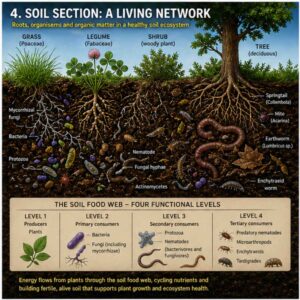 Plants, because of their ability to produce their food, contribute sugars and other molecules to the soil’s trophic network. This attracts microbial species that form symbiotic relationships with the plants, allowing for nutrient exchange and adequate protection. A dense microbial community develops around and within the root tips, acting as a protective shield and ensuring active metabolic processes in the soil, even under challenging biotic and abiotic conditions. The Soil Trophic Network consists of four levels:
1st Level: This level consists of plants, which are the primary producers of sugars. These sugars are exuded from the roots, extending into the surrounding three millimeters of soil. Additionally, plants exude sugars from their leaf surfaces to attract various microorganisms. For bacteria and fungi, these sugar exudates provide an essential energy source that sustains their life. Plants also contribute carbon-rich organic matter to the soil surface, including leaves, wood, bark, flowers, and pollen. These materials are decomposed by fungi and bacteria.
2nd Level: This level includes primary consumers, such as bacteria and fungi (including mycorrhizal fungi). They feed on sugars, which can vary in complexity depending on the species. The primary energy source for these organisms is the waste produced by plants, which bacteria and fungi decompose into simpler constituents that can be absorbed by plants. This process also leads to the production of humus.
3rd Level: This level encompasses secondary consumers, such as protozoa, bacteriophagous nematodes, and fungal nematodes. These organisms derive energy through predatory activity, allowing them to multiply and move throughout the dense trophic network. Their metabolic wastes enter the soil solution, where they can be directly assimilated by plants or reused by primary consumers.
4th Level: Similar to the previous level, this one includes predators, known as tertiary consumers, which survive by preying on all species from the previous levels. This group consists of omnivorous nematodes, predatory nematodes, microarthropods, Enchitradae, tardigrades, and a few other species. Like the other levels, this group also returns nutrients to the soil by producing soluble metabolic wastes that can be assimilated by plants.
Bibliography
Hazen Robert M. The Story of Earth, 2012.
Le Doux Loseph. The Deep History of Ourselves. The Four-Billion-Year Story of How We Got Conscious Brains, 2019.
Quammen David, The Tanglrd Tree. A Radical New History of Life. 2018.
Sheldrake Merlin. Entangled Life. How Fungi Make Our Worlds, Change Our Mind and Shape Our Future. 2020.
Stamet Paul. Mycellium running: hoe mushrooms can help save the world. 2005.