
by PhD Grazia Trebbi – Biologist, PhD, freelancer, and independent researcher, former university researcher; email: gtstudio1.6@gmail.com
Introduction
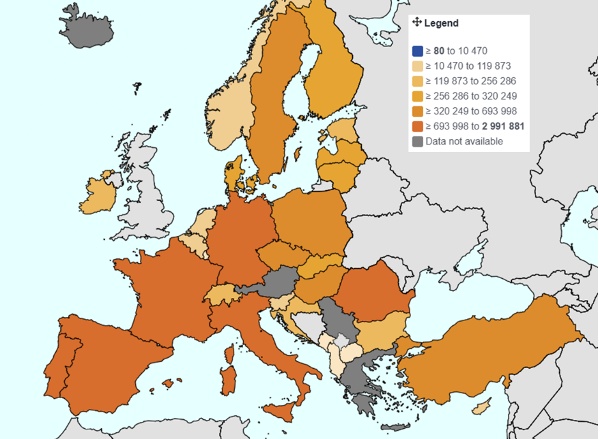
According to EU Regulation 2018/848, organic food production is a sustainable management system that aims to produce food using natural substances and processes. This method encourages respecting natural cycles, improving soil, water, and air quality, preserving ecosystem balances, and ensuring the responsible use of energy and natural resources. In recent years, the organic farming sector in the European Union (EU) has developed rapidly: in 2022, the organic farmland reached 16.9 million hectares (ha), standing for 10.5% of the total agricultural area used (Eurostat 2024). In Italy in 2023, organic farmland or in-conversion reached almost 2.5 million ha, ranking third after Spain and France. Figure 1 shows the EU distribution of organic farmland.
The organic market is constantly developing, especially thanks to the growing demand. According to the EU Eurobarometer survey on agriculture and the CAP (Common Agricultural Policy), consumers give more and more importance to organic products, trusting that they are more compliant with specific standards on pesticides, fertilizers, and antibiotics, more respectful of the environment and animal welfare (European Commission 2024). Given this, the legislation has provided for consumer protection laws, which in this way ensure the authenticity and conformity of the product. Such a guarantee is given by a certification system managed by regulatory bodies that verify compliance with European regulations. This process includes documental analysis and periodic on-farm inspections, which may also include sample collection for chemical analysis. The latter includes searching for residues of synthetic chemicals such as pesticides, quantifying contaminants such as nitrates, phosphorus, and heavy metals, analyzing substances such as nitrogen and polyphenols (which may differ between organic and non-organic products), and measuring organic ingredient content in processed products (at least 95% to ensure compliance with the legislation). So, this control system guarantees the authenticity of the product and its compliance with specific production methods.
However, whether organic products are of higher food quality than conventional ones are still under discussion, primarily because the concept of quality is complex and subject to different interpretations. There are in fact many aspects related to the quality of food products: those of an intrinsic nature, which we can evaluate using our senses such as color, appearance, taste and smell, and those of an extrinsic nature, which are not tangible but which are still part of the product, such as origin, production method, environmental sustainability and ethics (Espejel et al 2007). Considering safety, the quality of organic products is guaranteed by strict regulations that prohibit the use of pesticides, chemical fertilizers and GMOs (organic products tend to have fewer residues of pesticides and harmful substances). While their nutritional content compared to conventional products is still under discussion, in fact, to draw any conclusion, evidence is still too little due to bias (systematic errors) and confounding variables, and the short duration of most of the studies carried out (Giampieri et al2022; Rahman et al 2024). In addition, many pieces of research, addressing the nutritional quality of food products, are based on the analytical quantification of the single nutrients, whose values are reported in nutritional tables, and on the evaluation of their effects on health through a cause-and-effect approach (relationship between an event, the cause, and the result that comes from it, namely, the effect). This criterion is framed within a reductionist vision, which tends to consider a living being as the mere sum of the individual components linked to each other by cause-and-effect relationships. But at a closer look, the matter is more complicated, because the living organism is much more than just the set of single ingredients.From a systemic biology perspective, the living organism can be considered as a coherent, synergistic and highly complex whole (Sauer et al 2007): the plant or animal from which the food originates must therefore be seen as “the whole plant” or “the whole animal” endowed with characteristics such as shape, self-regulation, and resilience. Self-regulation is understood as the ability of organisms to adapt and maintain various physiological and biological parameters at relatively constant levels, while resilience is understood as “elasticity”, i.e., the ability to face challenges, resist, and recover from an adverse event through adaptation and growth. It is necessary to broaden the perspective and consider food beyond its reductionist aspect —simply a combination of nutrients. Instead, we should embrace a holistic vision as a product “of the whole plant” or “of the whole animal” and an active source of nourishment that influences the balance between body, mind, and spirit. In this perspective, the food product can also be characterized by a “holistic quality”, which represents it in its entirety, including not only the material substance of which it is composed, but also the “internal qualities” such as integrity and vitality inherent in it. Vitality shows the way in which an organism’s self-regulation expresses its ability to adapt and grow because of an unfavorable condition. It can be related to the product itself or to the effect of the product on the consumer (Kahl et al., 2012). Chemical analyses based on a reductionist quantitative approach are inadequate to detect such a level of quality; therefore, a different evaluation method is needed that can view the sample to be analyzed in its entirety qualitatively. A proposal in this sense is represented by the morphological-qualitative analyses based on the study of structures and shapes (Trebbi 2025). These methods are intended to characterize the product to be assessed on a morphological level and to derive qualitative information about the product from the training structures. The purpose of this work is to highlight and describe any differences between organic and conventional products through the application of these techniques, through the crystallographic method of evaporation of the drops (Droplet Evaporation Method, DEM).
The Droplets Evaporation Method (DEM)
The DEM is based on the formation of crystalline patterns (training models) induced by the evaporation process: the sample in liquid form is placed on a substrate and allowed to dry (Kokornaczyk et al 2011). During the phase transition of the solvent, any particles of matter present self-assemble under the action of different physical forces, forming crystalline structures at the edge of the drop or within it, with more or less complex shapes and varying degrees of order. The way in which the particles self-organize defines the morphological pattern that originates at the end of the evaporation phase. The creation of such training models depends not only on the flow dynamics during evaporation, but also on the external environmental conditions (temperature, relative humidity, hydrophilicity/hydrophobicity of the substrate, pressure and UV radiation) and internal to the drop, related to its composition (surface tension, wettability, viscosity, ionic strength, dispersion of colloids and thermal conductance) (Zang et al 2019; Wilson and D’Ambrosio 2023). However, when the drops are evaporated in the same environment under controlled conditions, their drying process depends exclusively on the composition of the liquid. Therefore, a slight difference in this aspect leads to changes in the phase transition during the drying process and, so, to a different pattern. The extreme sensitivity of the pattern formation process to the composition of the liquid makes the DEM method suitable for analyzing the quality of agricultural and food products. A preliminary blind test on a series of organic and conventional products, including cereals, fruits, vegetables, eggs, milk, and wine, showed that dem can discriminate between organic/conventional groups in 86.7% of the cases analyzed (Kokornaczyk, personal communication).
About the method, DEM involves placing the droplets to be evaluated on microscope slides, observing their evaporation under controlled conditions, observing the dried residues under the microscope, photographing the resulting patterns, and finally evaluating them (Trebbi 2025). Image evaluation can be conducted through a “personal” approach, through the visual and descriptive observation of the patterns by the observer, and/or through an “objective” approach through a computerized analysis with the aid of image processing software. The subjective approach based on visual perception allows for a qualitative evaluation of the image through the identification and description of shapes and patterns. The approach based on computerized processing allows for a quantitative evaluation of the image, which can be investigated through the creation of graphs and tables. The parameters that can be considered in a morphological analysis are various and include complexity, heterogeneity, order, symmetry, dimensional indicators, relationships set up between the parts and the whole, such as continuities or discontinuities, etc. Subjective or objective analysis of these aspects provides an overall morphological qualitative evaluation of the analyzed sample.
DEM analysis: comparison between organic and conventional products
This section presents a series of images of crystalline structures obtained from several types of unprocessed products (wheat, chickpeas, and walnuts) and processed (wine, apple juice, and blueberry compound) to evaluate the effects of the cultivation method on crystallization capacity. Images showing the impact of chemical fertilization on wheat soil are also included. This document presents a visual qualitative description of the most representative image for each product, chosen based on the most consistent patterns observed. The results provide a preliminary sign and serve as a starting point for expanding our understanding of the DEM method and its potential applications in agriculture. In addition, the visual or software evaluation of the set of images obtained in the experimental tests can provide a large database to be subjected to an in-depth statistical analysis (not reported here because it is outside the scope of this article), allowing the results to be interpreted and the initial hypotheses to be verified or not.
| Figure 2. Common wheat: crystalline structures derived from the organic (A) and conventional (B) samples. |
On unprocessed products, Figure 2 shows some images relating to crystalline structures of cereal seeds, of common wheat grown in an organic and conventional regime. At first glance, you can perceive the different degrees of structural complexity that characterize the two samples; in the biological one (Figure 2A) it is possible to identify a well-defined crystalline center in which a greater density of crystallized material is concentrated, organized in fractal-like dendritic patterns, formed by linear segments more connected to each other. Dendritic means that the crystal has a branched tree-like shape with branches that extend from a central core outwards; it is also fractal-like in that the crystalline structure can be approximated to a fractal object (a fractal an irregular shaped object, endowed with self-similarity: it repeats itself in its shape in the same way on different scales and, by enlarging any of its parts —when enlarging itself you obtain a figure that resembles the original). From the center to the outer part of the image, the crystalline pattern tends to thin out into individual small and isolated crystals, mostly in the shape of a cross. On the contrary, from the observation of the conventional sample (Figure 2B) the lack of structural “centrality” observed in the biological sample clearly emerges; there is also a lower density of crystallized material, organized in simple crystalline forms, not grouped and less complex, whose trait can be point-like, shaped like a cross or small, slightly branched dendrites.

Also, legumes are considered; in particular, chickpeas, some significant images are displayed in Figure 3. As can be seen, the difference between the two samples is clear. In organic chickpeas (Figure 3A) there is a geometric pattern characterized by main straight lines from which smaller segments appear, arranged perpendicularly to the main ones (dendritic growth), creating “cross”, “comb” or “antenna” structures. Furthermore, this pattern is replicated in various dimensions, reflecting the fractal-like nature of the training model. It is noticeable that the lines are perfectly equidistant and parallel to each other, creating a rigid grid. While the design is not centered or harmonious, it can be seen as somewhat ordered and has a degree of symmetry. In the conventional sample (Figure 3B) the amount of crystallized material is significantly lower; there are no complex, organized structures, but there are small and single-point crystalline forms, unstructured or connected.

Figure 4 shows some representative images of the crystalline structures of walnut samples from organic and conventional agriculture. The crystalline forms present in the biological sample are varied and include both lemniscate structures (inverted figure-eight shape, used in mathematics as a symbol to indicate infinity: it is a type of closed curve, symmetrical and representative of development, balance, harmony and unity, Figure 4A) and curved line motifs that intertwine with each other according to a scheme that recalls the helicoid or cluster branching of the selvedge and racemose inflorescences, better highlighted in Figure 5.

In both cases, the crystalline design is characterized by symmetry, balance, proportion, and harmony, which together convey a feeling of completeness and order. In the case of the conventional sample (Figure 4B), single crystalline structures are observed, isolated and not organized in a defined, recognizable pattern.

In addition to unprocessed products, DEM has also been applied to some foods that have undergone minimal processing, such as wine, apple juice, and blueberry compote. Figure 6 shows some crystalline structures derived from samples of red wine (Cabernet) and white wine (Pignoletto), organic and conventional ones. In organic samples, it is possible to see the presence of different shapes that together create a harmonious, balanced, tidy, and pleasant design. For example, the star shape in Figure 6A is characterized by an almost perfect five-sided symmetry in which the rays seem to respect precise relationships and proportions; moreover, secondary branches arise from these rays, and smaller tertiary branches arise from the secondary ones, and all these branches are well-defined into an equivalence relationship, resulting in all being parallel and creating a fractal-like structure. Furthermore, the structures observed in Figure 6B are characterized by curved lines that intertwine with each other according to a precise and proportional scheme (as also observed in the walnut sample) that, by proposing to our senses a harmonious balance of forms, arouses in us an aesthetic emotion and stimulates the sense of beauty, while evoking feelings of dynamism and movement.

On the other hand, the crystalline designs created by conventional wines have, in the case of red wine (Figure 6C), wide-thick structures that can be more or less circular (globular) or elongated (rod-shaped), with irregular margins. These forms do not have fractal-like dendritic ramifications but rather appear to be clusters of material apparently devoid of a specific structural motif. In the case of white wine (Figure 6D), the crystallized material present tends to form structures with unclear and precise contours: you can see wide-thick, elongated, rod-shaped structures, characterized by transversal septa and with some branching. However, in general, the final design is poorly defined, it is not organized in a symmetrical, orderly, well-recognizable, and repeatable structural model.
As for the apple juice, some indicative images of the biological and conventional samples are shown in Figure 7. The comparison highlights the presence in the biological sample of a well-defined arborescent training model, characterized by straight segments from which secondary branches emerge, which in turn give rise to tertiary branches (fractal-like dendritic pattern); in the conventional sample, there is an attempt by matter to self-organize in a pattern, but it is incomplete, partial andincomplete. In fact, next to areas in which the particles tend to structure themselves in a recognizable dendritic pattern, large areas are clear where the crystals are reduced to shapeless, dense, more or less large clusters or to single elongated structures with irregular contours.

Finally, some representative images of crystals obtained from biological and conventional samples of blueberry compote are shown in Figure 8. The images of the biological sample highlight a structural pattern with curved lines that tend to form lemniscates or circles/semicircles that

intertwine with each other, ending with branches that resemble the shape of a fan. In this case, too, the final design, endowed with a certain degree of order and symmetry, evokes movement and dynamism. On the contrary, the residues of the sample of non-organic blueberry compote (Figure 8B) have a much more heterogeneous, disordered and asymmetrical morphology than the previous one: in particular, the presence of dense and dense material is observed, inside which there are other elongated, straight, “stick” structures arranged randomly, confused, and chaotic.
In addition to verifying the effects of the cultivation method on several types of products, dem was also applied to evaluate the effects of chemical fertilization. This fertilization is based on the use of synthetic chemical fertilizers and is used in conventional cultivation systems. It is known that excessive use of chemical fertilizers can induce soil acidification, resulting in a reduction of organic matter content, humus, and the number of beneficial organisms (Chali Abate 2023). Their use does not follow the principles of organic production, which advocate for the use of natural substances, such as livestock manure or organic compost, as well as authorized fertilizers and soil enhancers. In the field of DEM application, it is interesting to verify whether chemical fertilization has an effect not only on the soil but also on the final product. To this end, an experimental test was conducted by growing common wheat on differently fertilized soils and evaluating the effect of the diverse levels of fertilization on the crystallization capacity of the seeds (Kokornaczyk, personal communication). The results are reported in Figure 9, which shows the crystalline structures deriving from seeds grown in soils with three increasing levels of fertilization (Figure 9, 1-3) compared to an unfertilized soil (Figure 9, 0). The crystalline structure of the zero-fertilization sample shows a complex yet orderly and recognizable pattern. The individual crystalline particles follow one another continuously and uninterruptedly, connecting with each other to form a single large structure with a fractal-like dendritic pattern. On the contrary, in the images of the seeds obtained from the plants that have received chemical fertilization, it is observed that as the levels increase, the crystalline structures begin to lose the fractal-like dendritic shape, becoming increasingly fragmented and point-like. They appear incomplete, disorganized, disunited and disconnected: they are devoid of order, the basic structural motif is no longer distinguishable and the cohesion and bonds between the particles are lost. This result can be interpreted as a decrease in the self-organization capacity of the matter contained in the samples derived from chemically fertilized soils.
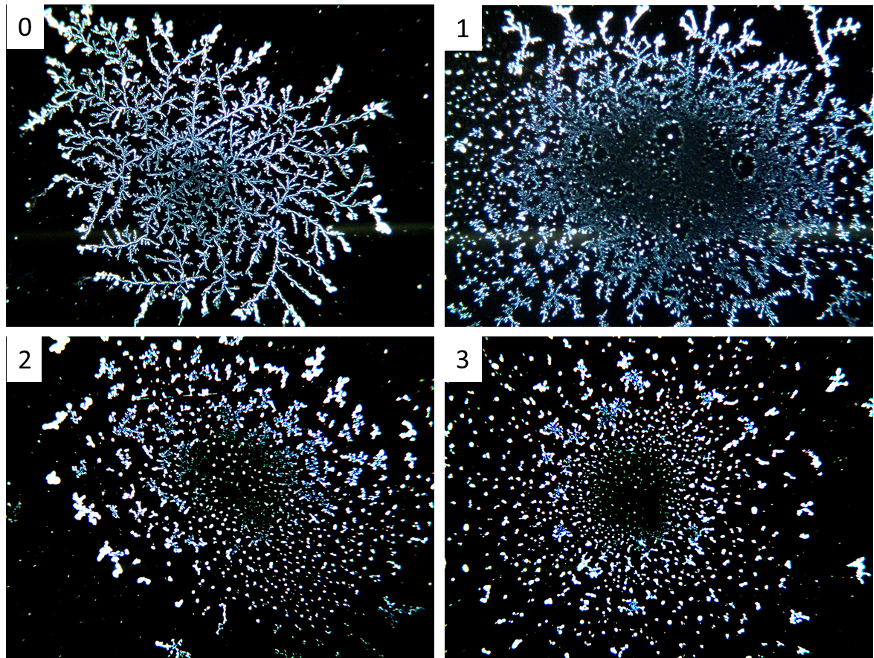
Figure 9. Crystalline structures of common wheat seeds grown with increasing levels (from 0 to 3) of chemical fertilization. Images published by the authorization of the author, Maria Olga Kokornaczyk
Conclusions
Based on the observations on the samples analyzed so far, it is possible to suggest that the crystalline forms derived from organic products are more complex, ordered, and symmetrical than those of conventional samples and, by combining harmoniously in structural patterns, give us aesthetic emotions and sense of beauty. The shaping capacity of matter, that is, the way in which it is structured in a more or less complex and harmonious crystalline form, can be interpreted as the manifestation of the property of self-organization of matter aimed at maintaining and protecting its integrity. Living organisms themselves are constantly committed to safeguarding their integrity from multiple external factors. Research in organic agriculture starts from the hypothesis that cultivation practices (fertilization, soil tillage, seed varieties, etc.) influence how an organism can maintain its integrity, and this deeply linked to the organism health, whether plant, animal or human (Velimirovet al 2010): a food product grown respecting the environment and natural cycles would be enriched with that full of vitality “qualitative something“, which could result in the creation of crystalline structures with an intact, harmonious, balanced and generating charm and pleasant patterns. Eating foods that have this characteristic could have beneficial and positive effects on the physical, mental and spiritual well-being of consumers, contributing to the maintenance of the delicate balance of these three dimensions. In this context, the DEM method has proved to be a suitable tool for the evaluation of this capacity and, more generally, of the holistic quality of agri-food products. In fact, systemic propertiessuch as integrity, self-regulation, and vitality cannot be evaluated by common methods of analysis, as aspects of an organizational structure cannot be interpreted only based on the individual components. A further element that underlines the potential of dem as a qualitative evaluation tool concerns the type of output (i.e., the result or the terminal element of a procedure) that is obtained at the end of the protocol. This element is not a numerical value, as is usually obtained from a quantitative measurement, but is an image that communicates and expresses itself through visual language. This type of language is an extremely effective communication vehicle; it is universal and can be understood by anyone; it is immediatebecause the brain processes images much faster than text; it is effective in capturing attention (an image arouses interest in a few moments) and promotes better memorization (people remember 80% of a visual content compared to only 20% of a text). Furthermore, images have a strong emotional impact; they can evoke deep emotions and convey the message instantly. Precisely through this communication channel, the choice of good, healthy and vital foods corresponding to beautiful images that arouse pleasant sensations could be promoted, stimulated and enhanced, thus improving and safeguarding the health of consumers and rewarding virtuous producers who decide to cultivate the land and raise animals respecting the principles of Nature.
Acknowledgements
I would like to thank Dr. Maria Olga Kokornaczyk for providing me with the images in Figure 9; agricultural technicians Elena Zaramella and Paolo Pistis for the nut samples; and farmers Giovanni Sassudelli and Roberto Denart for the apple juice and blueberry compote samples, respectively. A heartfelt and profound thanks goes to Dr. Lucietta Betti for sharing ideas and opinions on the topics covered by the study and for the critical review of this article.
References
Chali Abate J. 2023 The impacts of using inorganic chemical fertilizers on the environment and human health. OMCIJ 13(3): 555864. DOI: 10.19080/OMCIJ.2023.13.555864
European Commission 2024. Special Eurobarometer 556 – Europeans, Agriculture and the CAP. DOI 10.2762/5962409
Espejel J, Fandos C, Flavian C. 2007 The role of intrinsic and extrinsic quality attributes consumer behaviour for traditional food products. Manag Serv Qual 17(6): 681-701. DOI 10.1108/09604520710835000
Eurostat 2024 EU organic farming: 16.9 million hectares in 2022. https://ec.europa.eu/eurostat/web/products-eurostat-news/w/ddn-20240619-3last accessed 21/10/2025.
Giampieri F, Mazzoni L, Cianciosi D, Alvarez-Suarez JM, Regolo L, Sanchez-Gonzalez C, Capocasa F, Xiao J, Mezzetti B, Battino M. 2022 Organic vs conventional plant-based foods: A review. Food Chem 383: 132352 DOI.org/10.1016/j.foodchem.2022.132352
Kahl J, Baars T, Bügel S, Busscher N, Huber M, Kusche D, Rembiałkowska E, Schmid O, Seidel K, Taupier-Letage B, Velimirov A, Załecka A. 2012 Organic food quality: a framework for concept, definition and evaluation from the European perspective. J Sci Food Agric 92(14): 2760-2765. DOI: 10.1002/jsfa.
Kokornaczyk MO, Dinelli G, Marotti I, Benedettelli S, Nani D, Betti L. 2011 Self-organized crystallization patterns from evaporating droplets of common wheat grain leakages as a potential tool for quality analysis. Sci. World J 11:1712-25.
Rahman A, Baharlouei P, Koh EHY, Pirvu DG, Rehmani R, Arcos M, Puri S. 2024 A comprehensive analysis of organic food: evaluating nutritional value and impact on human health. Foods 13: 208. DOI.org/10.3390/ foods13020208
EU Regulation 2018/848. https://eur-lex.europa.eu/legal-content/IT/TXT/PDF/?uri=CELEX:32018R0848 last accessed 21/10/2025.
Sauer U, Heinemann M, Zamboni N. 2007 Genetics – Getting closer to the whole picture. Science 316(5824): 550-551. DOI: 10.1126/science.1142502
Trebbi G. 2025 Analisi morfologico-qualitative per la qualità dei prodotti agro-alimentari: introduzione al metodo di evaporazione delle gocce. Terra biodinamica 6: 39-54.
Velimirov A, Huber M, Lauridsen C, Rembiałkowska E, Seidel K, Bugel S. 2010 Feeding trials in organic food quality and health research. J Sci Food Agric 90: 175-182. DOI 10.1002/JSFA.3805
Wilson SK and D ‘ambrosio HM, 2023. 2023 Evaporation of sessile droplets. Annu Rev Fluid Mech 55: 481–509. DOI.org/10.1146/annurev-fluid-031822-013213
Zang D, Tarafdar S, Tarasevich YY, Dutta Choudhury M, Dutta T. 2019 Evaporation of a droplet: from physics to applications. Phys Rep 804 (29): 1-56.